Application
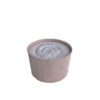
Calcined beeswax has been widely used since the Middle Ages to protect Italian decorative plasters—such as *stucco veneziano* or *marmorino*—from external factors. It can be applied to various mineral surfaces or wood for polishing and achieving high-gloss.
Application and properties:
The calcined wax is applied to dry, porous surfaces that have not been oiled or sealed. When combined with lime-based decorative plasters and putties, the wax it creates lime soap, and consequently, the coating becomes water-repellent. The wax creates a protective barrier against acids, and any potential contamination is easier to remove. The calcined wax is hydrophobic; the surface becomes antistatic and no longer attracts dust. Despite the wax coating, the surface remains breathable and open to diffusion.
Application:
The calcined wax is applied using a Venetian trowel and left to air-dry for 30–45 minutes. It is then polished to a mirror-like sheen using a wool or microfiber cloth or a polishing machine. For pigmented systems, non-conventional application methods—such as a sponge or brush—may also be used to achieve the desired decorative effect.
Consumption rate:
250 ml is sufficient for approximately 5–8 m², depending on the structure and absorbency of the substrate.